How the Salesforce Architecture Program Is Being Rebuilt with the Community


After a period of slowed updates, the Salesforce Architecture Program is back. The guidance architects depend on had fallen behind the pace of the platform, and the community made it clear something needed to change. In fact, Salesforce had effectively shut the program down, pausing updates entirely, before deciding to relaunch it in direct response to sustained community feedback. This relaunch didn’t begin with a traditional top-down announcement. Its return reflects months of ecosystem input that leadership has now translated into action. Recent updates, including an official Trailblazer Community coffee chat and posts from Salesforce’s Architecture team, offer a clearer look at what changed and why.

How Community Feedback Is Reshaping the Architecture Program
Listening Before Launching
Scott Musson (SVP, Office of the Chief Architect) and Miriam McCabe (Senior Director of Architect Evangelism) spent months working with the community, hosting focus groups and collecting more than 500 pieces of feedback to understand where the previous iteration fell short and what needed to change.
A Shift in Leadership Perspective
The program is being rebuilt with tighter connection to engineering and real-world practitioner pain points. After 14 years in platform engineering, Scott shared that he wanted more direct exposure to day-to-day challenges from architects and developers, not only executive escalations. A major theme they heard at events was how difficult it can be to push product feedback back into Salesforce, and he identified improving that path as a priority.
Triage Before New Releases
Before shipping net-new content, the team focused on cleanup. They reviewed the existing Architecture Center content to make sure there was nothing inaccurate lingering from the dormant period, then started planning updates and refreshes so the foundation is trustworthy again.
The Four Driving Themes of the Relaunch
Based on survey themes, the program is anchored on four clear community expectations:
- Relevance: Content needs to stay current and prescriptive, especially as areas like Data 360, integration, and AI evolve.
- Application: Architects want practical “how this works in real life,” not theory only. Expect more workshops, examples, and blogs designed to translate best practices into execution.
- Connection: Documentation helps, but peers help more. The team is increasing its presence at community events to support discussion, validation, and feedback loops.
- Findability: The content needs to be easier to browse and discover. They discussed improving how the Architecture Center is organized so it’s easier to see what exists and find what you need.
Taken together, these changes point to a different way of running the program. The reset didn’t start with new frameworks. It started with listening, cleaning up what already existed, and reshaping priorities around how architects actually work. With that foundation back in place, the program is now positioned to take on a much bigger challenge: redefining what Salesforce architecture looks like as AI and autonomous systems become core to the platform.

The “Agentic” Shift: Why Salesforce Architects Are Now AI Architects
The role of the Salesforce Architect has always been about structure, security, and scale. But as the ecosystem pivots toward Agentforce, the definition of “scale” is changing fundamentally. It is no longer just about volume of records; it is about the complexity of autonomous decision-making.
The newly relaunched Salesforce Architecture Center is making its biggest bet on the “Agentic Enterprise,” building on established architectural foundations to extend guidance for systems where humans and AI agents collaborate.
How the architecture roadmap is pivoting to support this new reality
A New Library for a New Era
The relaunch immediately prioritized a suite of new definitions and patterns specifically for Agentforce. The team has released foundational content covering Enterprise Agentic Architecture, Agentic Patterns, and the IT Architecture of the Agentic Enterprise. These are the blueprints for how autonomous agents will coexist with legacy infrastructure.
Defining the “Agent Development Lifecycle”
We all know the SDLC (Software Development Lifecycle). But how do you test, deploy, and monitor an agent that makes its own decisions? The program is introducing the Agent Development Lifecycle. This is critical for architects who need to apply the same rigor to AI behaviors that they previously applied to Apex triggers and flows.
Data 360: The Fuel for Autonomy
You cannot have a smart agent without unified data. The program is heavily emphasizing Data 360 as the prerequisite for AI. New decision guides on Data 360 Provisioning and Interoperability are designed to help architects answer the “build vs. buy” questions regarding data unification. As Miriam McCabe noted, keeping up with Data 360 is now as critical as keeping up with Core platform updates.
High-Velocity Documentation for High-Velocity Tech
During the community chat, Scott Musson noted that agentic technology is evolving far more quickly than other areas of the platform. As a result, the team is moving faster on Agentforce and AI-related updates than on more stable parts of the product, and rethinking documentation as continuously updated guidance rather than static manuals.
The Human Element in AI Architecture
Perhaps most importantly, the new content emphasizes that this is still a human discipline. New blog posts like “Architectural Decisions: A Human-Led, AI-Powered Approach“ highlight that while the agents are autonomous, the guardrails—Security, Compliance, and Reliability—must be architected by humans.
The Takeaway
The return of the Salesforce Architecture Program represents a deep reset in how Salesforce is engaging with architects. It begins with listening, rebuilding trust in the foundation, and bringing engineering, evangelism, and community feedback into closer alignment.
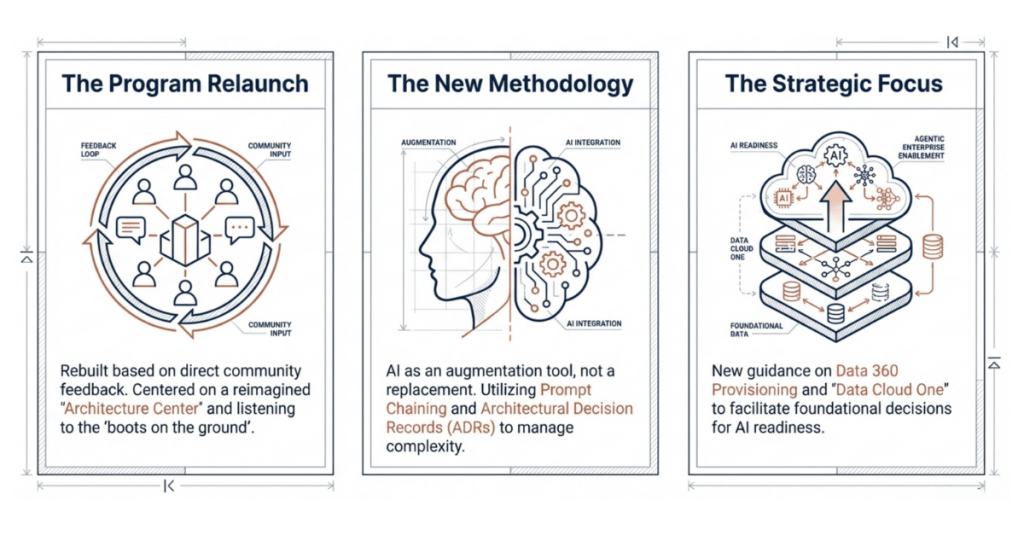
But the reset doesn’t stop at stabilization. With that foundation back in place, the program is now also aimed forward. As Agentforce, Data 360, and agentic patterns reshape what enterprise systems are capable of, Salesforce is positioning its architecture guidance around a new reality: architects are no longer only designing systems of record, they are designing systems of decision.
This shift from static documentation to living frameworks reflects a broad evolution in the role of the architect and in how Salesforce intends to support that role. The community is actively shaping what the next generation of Salesforce architecture will become.
Explore related content:
Trailhead GO: The Complete Guide to Salesforce Mobile Learning in 2026
The New Slackbot Is Here: What Salesforce Just Shipped, Why It Matters, and How Teams Should Use It