
The Mystery of the Vanishing F4: A Tale of Exceptional Support


How many times have you navigated the labyrinthine corridors of after-sales support and thought to yourself, “I wish there was just a real person on the other end, someone who understands common sense and can take care of this the way I would if I were in their shoes?” We live in an era of automated chatbots that loop you into infinity and “support tickets” that feel like they’ve been launched into a deep-space black hole. But recently, I had an experience that reminded me that somewhere, behind the cold glass of our monitors, there are humans who actually get it.

The Great Keyboard Heist
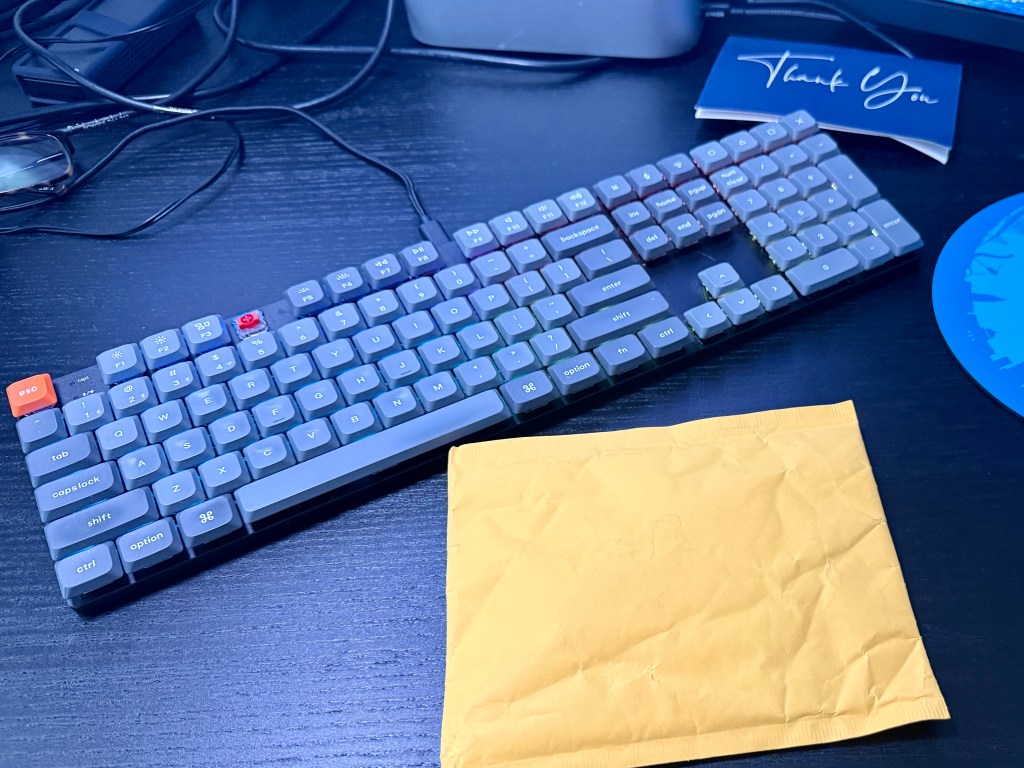
I had the weirdest incident the other day. I sat down at my desk, looked at my trusty Keychron mechanical keyboard, and realized that the F4 key had simply vanished. It wasn’t on the floor or in the desk drawer. It was just gone.

For those who aren’t initiated into the cult of mechanical keyboards, these aren’t your standard, mushy office planks. They are precision-engineered tools of tactile joy. They feature mechanical switches, which are the spring-loaded mechanisms under every single key that determine exactly how a click feels, sounds, and reacts. Some are “clicky” (sounding like a 1950s typewriter), some are “linear” (smooth as butter), and some are “tactile” (with a satisfying little bump).
I honestly do not know where my F4 key went. The best explanation I can come up with is that it was lost to an over-enthusiastic bout of cleaning. I know this sounds weird, but hear me out: I believe a vacuum cleaner sucked it away in a moment of domestic diligence.
The Dilemma of the Missing Cap
How do I deal with a missing tooth in my digital smile? The beauty of a Keychron is that it is built for enthusiasts. It features replaceable keycaps, which are the plastic “hats” that sit on top of the switches. In this hobby, people often “mod” their boards. You can swap your keycaps for different colors, materials like PBT (which is durable and matte) or ABS (which is smoother but can get shiny over time), and even different “profiles” or shapes.
I am not that far into this hobby yet, but the draw is undeniable: you can change your switches and keycaps from time to time for a completely different typing experience without buying a whole new unit. It’s like being able to change the tires and the interior of your car whenever you get bored with the commute.

I thought about buying another full set of keycaps. “I’ll change the colors or designs, and it will be a fresh new look on my desktop,” I told myself, trying to find a silver lining in my vacuum-induced tragedy.
Lost in the Catalog
I went to the website and found the model I had. Between the K-series, the Q-series, the V-series, and the “Pro” versions of each, it was a gauntlet. Then I found a few keycap sets that seemed to support my keyboard.
But here is where it got tricky. They did not have the exact same set I currently owned. The similar sets I found did not have the same number of keys. Some were for Tenkeyless (TKL) boards (keyboards without the number pad), and others were for 60% boards (ultra-compact versions that strip away the F-row and arrow keys to save desk space). The replacement sets I found were missing the arrow keys – those directional navigators we all take for granted until they’re gone.
I would hate to use my keyboard like this, with a gaping hole where F4 used to be, although I literally never hit the F4 key. It’s the principle of the thing! It’s like having a beautiful sports car with one hubcap missing. It still drives fine, but every time you walk up to it, you feel a small piece of your soul wither away.
The Waste of the “All-or-Nothing” Approach
I briefly considered buying an entire set just to use the F4 key. The price was not terrible – maybe $30 – but what a waste. I’d have 103 perfectly good keycaps sitting in a box in my closet for the next decade, eventually to be inherited by my confused grandchildren. I did not want to do that. It felt ecologically and logically offensive.
Then, I saw a chat window on the website. I asked which sets supported my exact model, still hoping to find a matching replacement set. The responder was quick but couldn’t solve it right there, telling me to write an email to the official support team.
I wrote to support, expecting a canned response like: “We do not sell individual keys. Please purchase the Full Artisan Gradient Sunset Set for $55. Have a nice day!”
The “Learned Resourcelessness” Trap
Instead, they replied and said they could send me a single replacement F4 key 🤯. I would only have to pay for shipping and handling of $8.
What a relief! But it also made me pause and reflect. How many times have I tried getting support and thought my request was getting lost among silos and rigid processes?
In these situations, I often think: “I wish I could just talk to a person like me who can go and get things done.”
In this case, I did not even think to ask – in my learned resourcelessness – whether they could send me a single keycap. We stop asking for simple, logical solutions because we’ve been trained to believe that “companies don’t work that way.” We assume the system is too rigid to handle a request for one tiny piece of plastic.
Why Sometimes “Raw” Support is Better Than “Polished” Support
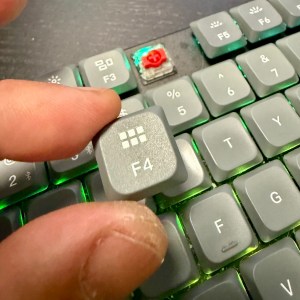
If it was me on the other side of that help desk, I’d do exactly what Keychron support did. I’d reach into a bin, find the key, and say, “Just pay for the postage, and it’s yours.” And that is how things ideally should work. I am sure that is not how it exactly went down, but I would like to think that it did.
These types of solutions result in less waste, less cost, and produce excellent customer satisfaction. That’s how support should be run. It’s the “human-to-human” model of business.
In fact, the solution was so “raw” – maybe somehow makeshift – that I had to fill out a PayPal form to take care of the shipping cost. To handle the $8 fee, the form added 8 “products” with the amount of $1 to my cart.
The geek in me absolutely loved this. It’s a “workaround” – a clever hack to use an existing system to solve a non-standard problem. There is nothing wrong with not automating the tail cases. These cases happen so rarely that it’s not worth writing a million-dollar piece of code to fix them. You just need a human with a PayPal link and a padded envelope.
Celebrating the Small Wins
We tend to talk about bad support experiences a lot. We vent on social media when a company fails us, or when we’ve been on hold for forty minutes listening to elevator music. It was about time I wrote an article about a process that actually worked well.
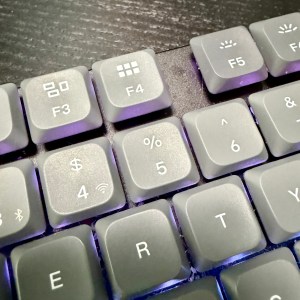
This wasn’t a grand, life-changing event. It was just a tiny piece of plastic. But it represented a company that empowers its employees to be helpful rather than just being “compliant” with a script. It’s the difference between a company that wants your money and a company that wants you to keep enjoying their product.
To be clear: This post is NOT sponsored by Keychron. They have no idea I’m writing this. It is based entirely on my real-life experience that I captured and published because it made my day a little bit easier.
Now, if emerging startups could have just found a way for me to talk my vacuum cleaner into giving back my original key, I wouldn’t have spent an hour working on this solution. I am not holding my breath until that day comes. I am just happy to know that $8 and a little bit of human empathy still saves keyboards from a life of incompleteness.
Explore related topics:
Salesforce Launches Free CRM: How It Stacks Up Against HubSpot and Zoho in 2025
My Experience with the New Certification Exam Platform
One Simple Salesforce Flow Hack That Will Change Your Workflow Forever!

