
Understanding the Role of Data 360 and Salesforce Architects in the Age of Agentic AI

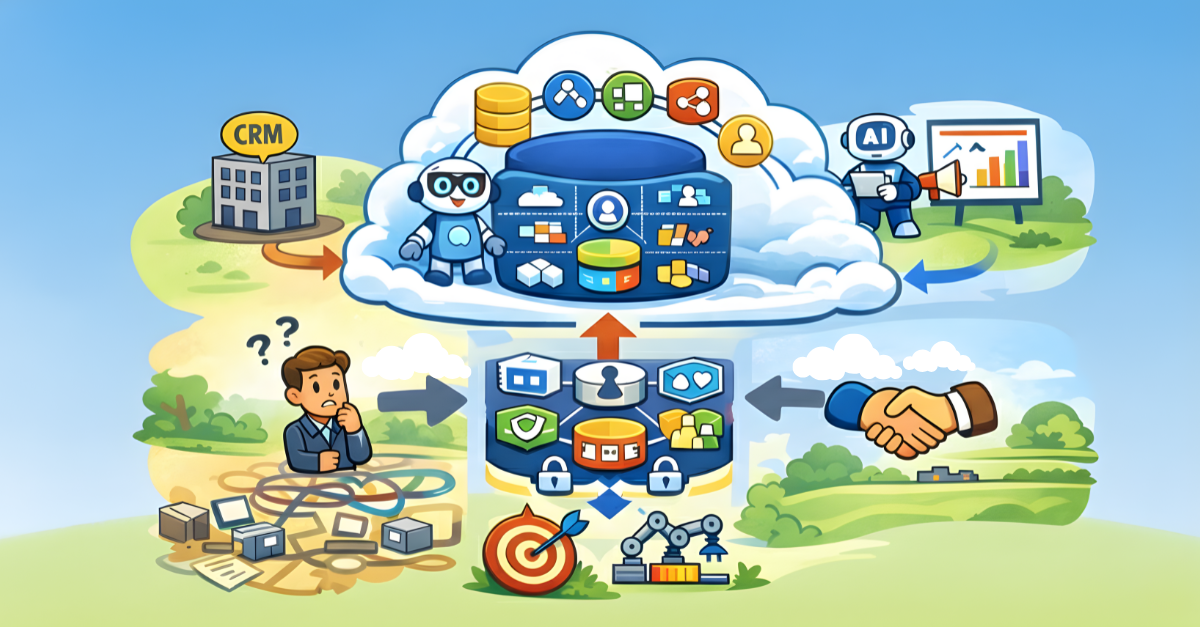
Over the last few years, Salesforce has renamed products (Customer 360 → Genie → Data Cloud → and now the broader Data 360 portfolio), expanded its platform, and introduced Agentforce—extending enterprise AI capabilities that began with Einstein’s predictive foundations.

What hasn’t changed is the architectural questions most organizations still struggle to answer:
- What is the (single?) source of “truth”: when data is spread across CRM systems, data lakes, analytics platforms, collaboration tools, and now generative and agentic AI repositories?
- How do we design an architecture that leverages existing investments where they already meet the business need, while making data actionable without sacrificing governance, compliance, or delivery velocity?
This is one of the core missions of today’s enterprise, and Salesforce, architect.
Understanding what the Data 360 portfolio actually enables is now foundational to that role.
What Data 360 Actually Enables (Beyond the Name)
Data 360 isn’t “just another data platform.” It serves as a composition and curation layer that makes enterprise data usable, governable, and ready for action where work actually happens.
Key capabilities include:
- Connectors to bring data from virtually anywhere
- Data Transforms to filter bad data, standardize what matters, and normalize information into a usable shape
- Identity Resolution to form unified customer profiles across structured and unstructured data
- Calculated Insights and Segmentation on curated datasets powering analytics, automation, activation, and AI
- Data Spaces to create contextual views based on what users are allowed, and intended, to see
- Clean Rooms to securely collaborate with partners while maintaining governance boundaries
Together, these form a trusted foundation for downstream use cases, rather than pushing risk and complexity into every consuming application.

Data 360 further extends the structured data capabilities with the ability to:
- Ingest and index unstructured data and make it accessible through a large language model
- Provide the persistence layer for structured data extracted from unstructured data to ensure consistent operations
In short, Data 360 provides contextual insights, so you can take advantage of structured and unstructured data spread across your existing architecture.
Rethinking Data 360 as Architectural Pattern Enabler vs a Product
Data 360 is often described as a “system of reference” or “source of truth.” From an architectural perspective, it is best understood as a curated, governed system of reference that sits between raw source systems (and existing data lakes) and activation layers such as CRM workflows, analytics, marketing journeys, and AI agents.
At its core, this pattern enables:
- Actionable data grounded in a complete, governed understanding of customer information
- Contextual views that respect role-based access and compliance boundaries
- Reduction of historical silos without forcing premature consolidation
The technology itself is not the goal. Its value lies in enabling trusted data that can safely drive decisions, automation, and AI outcomes.
Data 360’s Super Power: Architectural Choice
One of Data 360’s most under appreciated strengths is the range of architectural options it provides, allowing architects to meet organizations where they are and define a credible path forward quickly.
The goal is to reduce the distance between technical implementation and business value, without costly or risky “rip-and-replace” initiatives (such as org merges) or in-production data cleanups that are often desired but rarely executed well.
For Example:
- Existing data lakes? Use Zero Copy to bring data closer to business users—Tableau analysts, CRM admins, sales and service teams, or marketers—without duplication.
- Disconnected datasets or stalled MDM efforts? Achieve meaningful progress through unified profiles in days, not months.
- Known bad data (duplicates, fake contact points, insufficient granularity)? Use Data Transforms to curate a trusted layer without risking production systems.
- Little or no structured knowledge content? Incorporate web content and external sources contextually through LLMs, grounded in Data 360.
What once required ten or more disconnected “best-of-breed” tools can now often be achieved with 80% or more of the needed capabilities delivered through a single platform, augmented selectively by the ecosystem.
Agentic AI Changed the Stakes and Urgency for Meaningful Action
Agentic AI systems don’t just answer questions, also they take actions. This shift amplifies every unresolved data issue:
- Data silos means incomplete understanding of the customer, where ensuring data is current, consistent, correct, or contextual becomes impossible.
- Bad data leads to AI hallucinations or incorrect responses, which can lead to bad decisions or compliance risk.
- Technology experiments that are intended to create faster AI adoption and value can lead to more data siloes and security risks.
In this world, architects need to ensure not just “good enough” data that is verified as fit for business purpose. They also need to ensure the right metadata and architecture are in place.
Data 360 “Portfolio” Brings Together Related Data Capabilities
At Dreamforce 25, along with the product name change, Salesforce also announced the Data 360 Portfolio, which includes the Data 360 product, Tableau, MuleSoft, and now Informatica.
- MuleSoft already provides the Data 360’s data connectors
- Tableau Next is built on Data 360, so accelerate analytics on unified and contextualized data sets, with the semantic layer enabling conversational interaction with large data sets
- I predict Informatica’s MDM capabilities will be one of the first to be incorporated into Data 360 to extend data stewardship and advanced data management capabilities where Data 360’s identity resolution capabilities may not be sufficient. For example, there is no account hierarchy management or data stewardship features in Data 360 today, capabilities that may be added through Informatica’s capabilities.
The Architect’s Role Has Never Been More Important
Salesforce architects play many roles across projects. They evaluate and recommend technology choices while balancing security, availability, scalability, performance, usability, and cost to serve. Increasingly, they must also think of themselves as stewards of sustained business value.
An architect’s responsibilities increasingly include:
- Decomposing business use cases to architecture capability needs
- Making data-driven recommendations grounded in understanding of the current state of data, not just application architecture
- Defining rapid proof-of-value projects that demonstrate business benefits and what needs to be remediated
- Positioning Data 360 as a time-to-value accelerator for stakeholders, with evidence and examples
- Guiding architectures that ensure trusted data, with comprehensive data management and monitoring capabilities in place
In an Agentic AI world, poor architectural decisions don’t merely slow projects, they amplify risk, from trust erosion to compliance exposure. Good architecture does the opposite.
Data 360’s Architecture Advantage: Fewer Integration Points, Lower TCO and Governance Risk
With the power of architectural choice, Data 360 enables architects to drive faster business value with lower data reliability and compliance risk. It does this by increasing the return on existing data assets, improving total cost of ownership, and reducing architectural fragility through intentional design.
Historically, many organizations evolved siloed architectures: data lakes accessible primarily to IT or data engineers; separate repositories for analytics (such as Tableau Server or extracts), customer data platforms, and data science environments; and bespoke integrations built to serve individual teams. While each system solved a local need, the result was widespread duplication of data preparation and transformation work, often implemented differently in each place. This fragmentation increased development effort, drove up operational and compliance costs (for example, consistently honoring GDPR right-to-be-forgotten requests), and almost guaranteed inconsistent interpretations of the same customer or business entity.
Data 360 changes this dynamic by tapping into what already exists and streamlining how data is curated, governed, and activated. It provides a practical path to unify understanding without forcing immediate consolidation, while also establishing a foundation that can simplify the architecture further over time when, and only when, it is warranted. In doing so, it supports a trusted, enterprise-wide system of reference that enables better business decisions, more effective employee workflows, and safer, more predictable agentic decision-making.
An Invitation for Honest Conversation
If this perspective resonates, you are likely already delivering disproportionate value: not by knowing every feature, but by knowing where architecture decisions matter most.
- Comment with what you appreciated
- Share and amplify the message
If you disagree, I’d welcome the counter-examples:
- Where do alternative architectures outperform this model today?
- What trade-offs are worth making, and which are not?
Agentic AI raises the bar for all of us. The only way we meet it is by sharing what works, what doesn’t, and why, together.
Explore related content:
Salesforce Spring ’26 Brings Major Debug Improvements to Flow Builder
What’s New With Salesforce’s Agentblazer Status in 2026
Spring ’26 Release Notes: Highlights for Admins and Developers

