Slackbot Just Got 30 New AI Features


On March 31, 2026, Salesforce announced more than 30 new AI-powered capabilities for Slackbot. Together, all the new updates reposition Slack, and Slackbot specifically, as the central nervous system of the modern enterprise.

Slackbot can now orchestrate complex workflows across your entire org. It can manage customer relationships on your behalf, and follow you across your desktop and offer real-time help in any app you’re working in. Slackbot functions as a Model Context Protocol (MCP) client, routing tasks to Agentforce and thousands of connected apps. It transcribes meetings, logs action items, and updates your CRM the moment a call ends. And it does all of this without a new install, a new configuration, or a new login. Here’s a closer look at what’s new.
What Is Slackbot, and Why This Update Matters
Slackbot is the AI agent that lives natively inside Slack. Until recently, it could draft emails, schedule meetings, and sift through inboxes. Those were of course useful tricks, but Slack had bigger plans.
Today’s version of Slackbot is something categorically different.It can orchestrate workflows across your entire org, manage customer relationships, and follow you across your desktop to offer real-time help in any app you’re working in. And it can do all of this without needing a new install, a new configuration, or a new login.
Slackbot Gains Reusable AI Skills
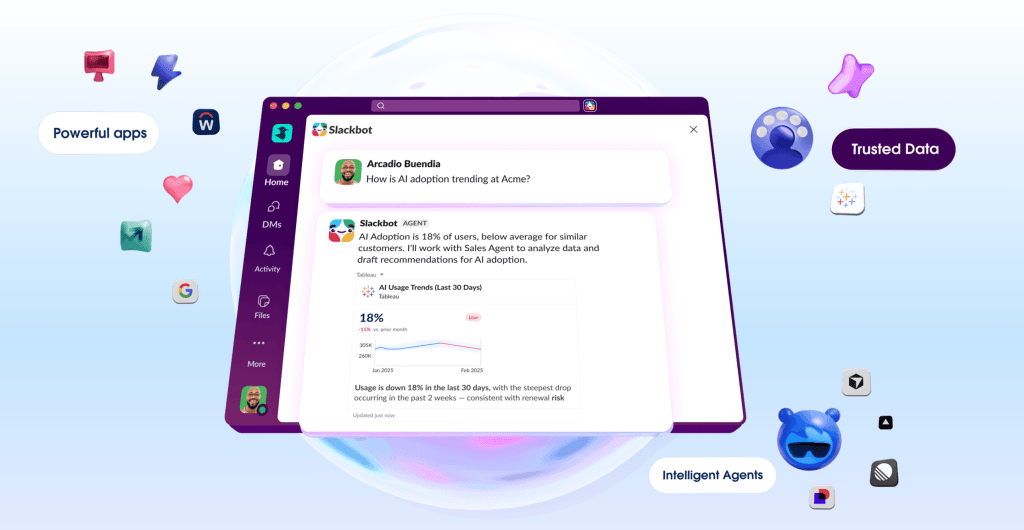
One of the most significant additions is reusable AI skills. These allow any team to define a repeatable task once and run it anytime, automatically. Think about how much time your team spends rebuilding the same context from scratch. Campaign briefs. Pipeline summaries. Budget documents. Each one follows the same steps, same format, same inputs, but someone has to reconstruct it every time.
AI skills eliminate that repetition. A user can build an AI skill for a task like creating a budget, for instance. After that, they simply type a prompt in Slack. Slackbot recognizes the match and executes the skill without being explicitly told to use it.

Furthermore, Slackbot ships with a built-in library of default AI skills. These cover the most frequently needed workflows across common business roles. However, teams aren’t limited to those. Users can build custom skills from scratch or let Slackbot identify recurring patterns in their work and suggest building a skill from them. Perhaps most importantly, published AI skills become shared standards. What one person builds, everyone can use.
Slackbot Is Now an MCP Client: It Talks to Everything
Additionally, Slackbot has been upgraded to function as a Model Context Protocol (MCP) client. For anyone unfamiliar, MCP is a framework that allows AI agents to connect with and use third-party software tools.
In practice, this means Slackbot can now route tasks and questions to Agentforce (Salesforce’s AI agent development platform) or to any connected enterprise app, without the user needing to know which system handles which task.
The scale of that access is hard to overstate. Through its MCP client capabilities, Slackbot can reach more than 2,600 apps in the Slack Marketplace. It can also access more than 6,000 apps built for the Salesforce AppExchange over the past two decades. The user simply describes what needs to happen. Slackbot figures out the path and gets it done (source).
Slackbot Now Follows You Across Your Entire Desktop
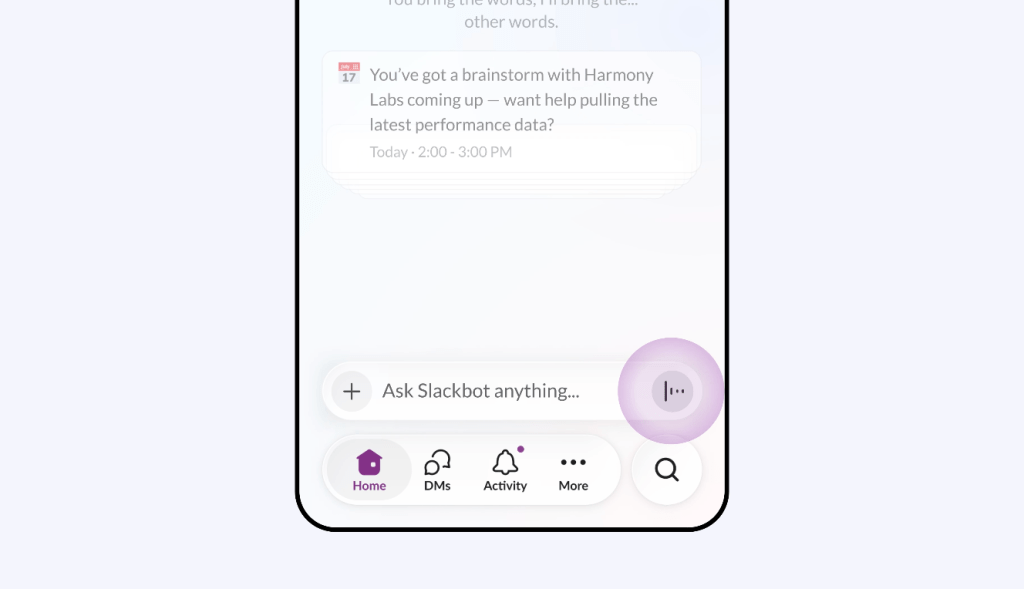
Here’s where things get especially interesting. Slackbot is venturing out of the Slack interface. It can now travel with you across your desktop as you move between apps. According to Salesforce, Slackbot already has full context on your open deals, past conversations, upcoming meetings, and how you typically work. That context travels with it wherever you go. Select any text on your screen and ask Slackbot to summarize it, draft a follow-up, flag risks, or give you a status update. Type the request or say it out loud.
Unlike other desktop agents that start from scratch each time, Slackbot starts from your existing context. That prior knowledge is already baked in.
Of course, this level of access raises reasonable privacy questions. Salesforce has addressed this directly. According to Slack’s General Manager Rob Seaman, multiple privacy and safety guardrails are built into Slackbot. Users have control over what it can and cannot access, and the governance already established in Slack carries over automatically.
Meeting Intelligence That Follows Through
Slackbot’s new meeting transcription and note-taking capability is a recording tool, and a follow-through engine.
Because Slackbot runs natively in the Slack desktop app, which tens of millions of people already use, there’s nothing new to install. When enabled, Slackbot listens in the background during meetings. The moment the call ends, it delivers a structured summary in Slack, complete with decisions made, action items assigned, and next steps captured.
Moreover, because Slackbot is natively connected to Salesforce, those notes don’t stop at Slack. Actions get logged. Opportunities get updated. Next steps are captured directly in the CRM. The meeting ends, and the follow-through is already done.
CRM for Small Businesses: No Migration Required
Enterprises aren’t the only ones who stand to benefit. Salesforce is also using this update to bring CRM capabilities to small businesses directly inside Slack.
Many small business owners are also their own sales department. Their customer conversations happen in Slack, but there’s rarely time to organize those interactions into formal records. Slackbot’s new native customer management capabilities change that.
Slackbot can now read your Slack channels, understand what was discussed, and automatically update deals, contacts, and call notes. If a promise was made to follow up, Slackbot logs it and reminds the owner later. If a new contract comes through, it gets filed to the appropriate client record. No migration to a full Salesforce org is required to get started, though scaling up when the time comes is frictionless.
Early Results: Adoption Is Already Moving Quickly
Salesforce reports that Slackbot is on track to become the fastest-adopted feature in company history. Customers including Anthropic, Wayfair, and others are already in production. Some employees report saving up to 90 minutes per day, the equivalent of reclaiming more than two months of working hours annually.
Inside Salesforce itself, teams are reportedly saving up to 20 hours per week. The company says this has already generated more than $6.4 million in internal productivity value.
Conclusion
Salesforce is making an architectural argument here. The bottleneck in enterprise AI is shared intelligence. Most AI tools today are single-player. One person, one tool, one conversation. But the biggest work happens between people, in channels and threads and meetings that accumulate context over time.
With Slack’s MCP server now generally available, more than 50 partners, including Anthropic, Google, and OpenAI, are building context-aware agents directly inside Slack. The enterprise AI stack is increasingly a team sport, and Slack is quickly becoming the arena. It’s becoming the layer where AI from across the industry shows up to do real work. Whether Slackbot delivers on its full promise will depend on how well the rollout executes over the coming months.
Explore related content:
The New Slackbot Is Here: What Salesforce Just Shipped, Why It Matters, and How Teams Should Use It
Bring Customer Data into Slack with Salesforce Channels
Connect Slack and Salesforce and Get More Out of Both Platforms

