Advanced Topics & Resources

Let’s talk about advanced Salesforce topics and resources regarding flow automation this week. As Salesforce continues to evolve, staying up to date with the latest best practices and insights is critical for any flow builder looking to optimize automation strategies.

I want to highlight two sources of information that Salesforce recently published. These resources provide valuable insights into the execution context of flows and advanced record-triggered automation strategies.
Understanding Flow Running User and Execution Context
One of these resources is the blog post titled “Your Guide to Determining the Flow Running User and Its Execution Context” by Jennifer W. Lee. You can read the blog post here.
It has been a mystery for many flow builders what context different flow types run in. For example:
-
If I create a record-triggered flow, can it update all records in my org?
-
What happens when I activate and run an event-triggered flow?

-
How does the running user affect the behavior of my flow?
All these questions have been answered in this blog post, making it a must-read for those looking to deepen their understanding of flow execution.
Key Takeaway: Screen Flows and System Context
One particularly interesting observation from Jen’s blog post is how screen flows behave in a public community (digital experience) environment.
I have built several screen flows that run on public community pages, and even when I set the flow to run in system context without sharing, it would not recognize or access related records in the org as expected. To work around this, I had to set up sharing rules in advance, ensuring that the guest user could see the necessary records.
Jen’s blog post sheds light on why this happens: Lookups in your screen flow do not run in the system context without sharing. This means that even though the flow has been given elevated permissions, it still adheres to standard sharing rules when retrieving records.
This distinction is crucial when designing screen flows that interact with related data. If you’re working on automation for Experience Cloud, it’s essential to preemptively configure sharing settings to ensure your users can access the required data.
A Deep Dive into the Architect’s Guide to Record-Triggered Automation
Another incredibly valuable resource is the Architect’s Guide to Record-Triggered Automation. You can read the full guide here.
I should clarify that this has not been recently published, but there was an earlier version of this page. However, this is not merely an update—it has been completely rewritten and is immensely more helpful than the previous version.
This guide is useful for flow builders of all levels, but I want to emphasize that some sections are highly advanced. If you don’t understand everything at first, don’t be alarmed—that’s completely normal. The content is intended to be comprehensive, addressing key architectural considerations for scalable, efficient automation.
Key Takeaway: The Performance Impact of Complex Formulas
One of the most intriguing insights in this guide is about formula usage in record-triggered flows.
Essentially, the document warns that complex formulas do not scale well in high-volume flow execution scenarios. When a flow runs thousands of times per day, heavy formulas can become a performance bottleneck, leading to inefficiencies and slower execution times.
Best Practice: Use Formula Fields Instead of Complex Flow Formulas
To mitigate performance issues, I often use formula fields on the object itself rather than constructing intricate formulas within the flow. By leveraging a pre-calculated formula field, I can reference it in my flow without forcing the system to recalculate the formula dynamically at runtime.
The best architectural solution will depend on multiple factors, including:
-
The type of flow being built
-
How frequently the flow is executed
-
How often object records are accessed and displayed in the org
By evaluating these factors, you can determine whether using an inline formula in Flow is appropriate or if a dedicated formula field would be a better choice.
The Mark of a True Flow Architect
I wanted to explore this topic in depth to emphasize one important point:
There are many capable flow builders on the Salesforce platform, and a growing number of admins are becoming highly proficient in automation. However, a truly exceptional flow builder is someone who:
-
Deeply understands both declarative automation and platform architecture
-
Knows the limits of Flow and when to use alternative solutions
-
Can design scalable, efficient automation that aligns with Salesforce best practices
Mastering Flow is not just about building automation—it’s about architecting solutions that scale. The best flow builders don’t just create workflows that work today; they anticipate future needs, optimize for performance, and build with long-term sustainability in mind.
For anyone aspiring to be a top-tier automation expert, I highly recommend diving into these resources. They provide critical insights that will help you design better, more efficient flows.
Read the Architect’s Guide to Record-Triggered Automation here.
Recently published resources:
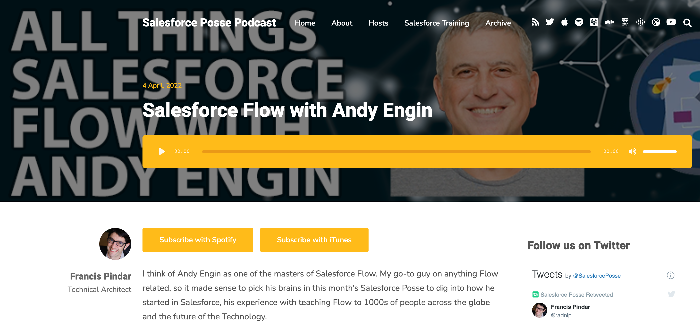
- I was a guest at Francis Pindar’s Salesforce Posse Podcast. Francis is a Technical Architect and has a course published on Udemy with 80K+ students. Check out the podcast episode here. And please make sure to check the learning resources on his website here.
- Salesforce started updating and rolling out Trailhead content on flow. Check out the “Record-Triggered Flows” module by Salesforce Trailhead here.
Explore related content:
15 Effective Salesforce Flow Debug Strategies


4 Comments