Salesforce Rebuilds Licensing Tiers and Adds Agentforce
Core, Advanced, Max: Everything Included in Salesforce's New Editions


If you’ve spent the past year stitching together separate purchases for Agentforce, Slack, Tableau, and security add-ons, we have some good news. Salesforce just rolled out three new, simpler edition tiers: Core, Advanced, and Max, and folded all of it into one purchase.
Don’t confused this with a feature update; it’s actually a buying model change. And buying model changes are usually the ones that actually change what shows up in your org.
What Comes Standard in Core, Advanced, and Max Editions
Every tier now ships with the same six components built in:
- Agentforce: including Account Research, Service Rep Assistant, and Agentforce Coworker
- Slack and Slackbot: putting agents and humans in the same conversational workspace
- Embedded agentic analytics: built on prebuilt semantic models
- Data security: covering sensitive data and permission changes as AI scales
- Premier Success Plans: for guided adoption support
- Flex Credits: starting at 500,000 for Core and scaling to 2.75 million for Max
That last one solves a problem we hear about often: teams want to experiment with agents but get stuck negotiating consumption contracts before they can test anything. Bundled Flex Credits remove that obstacle.
Agentforce’s Reasoning Engine Powers These Editions
Salesforce defines Agentforce as an autonomous AI application layer that reasons through requests, retrieves business data, and takes action rather than just answering questions. It is a proactive, autonomous AI application that answers questions, takes actions, and improves productivity, built to execute tasks according to a company’s specific role. The underlying reasoning runs through what Salesforce calls its Atlas Reasoning Engine, which breaks a request into smaller tasks, evaluates each step, and proposes a plan until the answer or action is complete.
In terms of these new editions, Account Research, Service Rep Assistant, and Agentforce Coworker aren’t separate products bolted together. They’re role-specific configurations of that same reasoning layer, which is why bundling them into one tier simplifies deployment instead of just simplifying the invoice.

The Tableau Next Piece Behind “Embedded Agentic Analytics”
The analytics component in these editions isn’t a watered-down reporting add-on. It’s Tableau Next, Salesforce’s newer analytics platform built specifically for the agentic era. Tableau Next is a flexible, API-first analytics experience built on a composable architecture, with a unified data layer and trusted semantics.
The piece that connects directly to Agentforce is Tableau Semantics, a layer that unifies business data with trusted definitions, accelerating time to insight and giving agents deeper business context. Practically, that means the agents included in these editions aren’t just querying raw records. They’re reasoning against defined, governed metrics, which reduces the risk of an agent citing inconsistent numbers across departments.
Tableau Next also ships native Slack integration, letting teams pull live metrics and ask data questions directly inside a channel or DM rather than switching to a separate analytics tab. For admins already managing Slack rollout alongside Agentforce, that overlap is worth flagging to your team early, since it changes where people will expect to find their reporting.
Premier Success Plans: Beyond a Support Ticket Queue
Premier Success Plans is the piece most likely to get overlooked in a features list, but it’s an important inclusion. Salesforce structures it around three areas: onboarding and strategy alignment, ongoing health checks, and expedited technical support.
On the support side, Premier includes a one-hour response time for business-stopping issues, along with developer support for troubleshooting custom code, including pro-code Agentforce solutions. For orgs running custom Apex alongside Agentforce, that developer support line is worth knowing about before you need it, not after.
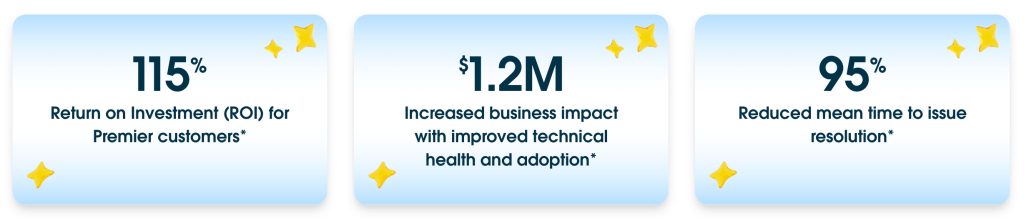
Salesforce also points to a commissioned Forrester study showing measurable outcomes for Premier customers, including a 95% reduction in mean time to issue resolution. We’d treat that as a directional data point from a vendor-commissioned study rather than a guarantee, but it’s a reasonable signal that the support tier is not purely cosmetic.
What Each Tier Actually Includes
Core Edition: $195 Per User/Month
Core replaces the legacy Enterprise Edition, delivering 70% more value at its new price point, according to Salesforce. It covers the baseline every org needs to start running agents in production. It includes Agentforce, Slack and Slackbot, embedded agentic analytics, data security, and Premier Success Plans, alongside 500,000 Flex Credits.
On the sales side, Core includes Momentum, so CRM records stay current without manual updates. It does not include Sales programs or the Agentforce Help Agent, so teams needing structured playbooks or autonomous customer-facing service resolution will need to look at Advanced.
Core fits smaller teams or orgs still testing their agentic strategy. It gives you the full security and analytics foundation without paying for capabilities you’re not ready to use yet.
Advanced Edition: $395 Per User/Month
Advanced replaces the legacy Unlimited Edition, delivering more than 50% more value at its new price point. It doubles the Flex Credit allocation to 1 million and adds the features that move Agentforce from experimentation into active deployment.
Sales programs unlock here, giving sales leaders structured, repeatable playbooks and incentive tools across deal cycles. On the service side, Advanced adds the Agentforce Help Agent, which autonomously engages customers across channels using outcome-based pricing, so you only pay when it resolves an issue.
Advanced is the tier most growing teams will land on. It closes the biggest capability gaps from Core without the cost jump to Max.
Max Edition: $550 Per User/Month
Max replaces the Agentforce 1 Edition. Price holds flat at the old Agentforce 1 rate, but Max now delivers roughly 60% more included value, plus 2.75 million Flex Credits.
Max is where the internal-facing tools live. Unmetered Agentforce Service Rep Assistant access gives every rep full Coworker access and a complete library of service agent templates. Agentforce Workforce Engagement adds AI-powered staffing and coaching. Agentforce IT Service automates employee help desk resolution.
Max makes the most sense for orgs running Agentforce across both customer-facing and internal teams at scale, where the added tools see regular use rather than sitting idle.
How to Evaluate Which Edition Fits Your Org
Before you assume any tier covers your team’s needs, map the feature list against what you actually use. A “Max” upgrade sounds like an easy yes, especially at unchanged pricing, but the value only lands if your org uses the tools that got added.
We’d also treat Salesforce’s value percentages as vendor claims rather than settled fact. They’re useful directional signals, not numbers to build a budget justification around without your own math behind them.
Industry Edition pricing isn’t final yet. Salesforce says that lands later this fall, so orgs in regulated industries should hold off on locking in a decision until that detail arrives.
Explore related content:
Which Salesforce Certifications Do I Get Next?
Slack Code: AI Coding Agents Have Entered the Team Chat
Claudeforce Explained: Salesforce and Anthropic’s New AI-CRM Partnership

